Commercial Roof Repair in Allen, TX
A repair should stop a failure without creating a second one beside it. In Allen, that means finding where water or wind entered, checking how far the condition extends, and confirming that the surrounding roof can accept a lasting repair. We inspect the membrane, seams, perimeter, curbs, drains, and prior patches before choosing materials. A dark ceiling mark does not identify the roof opening by itself, and a loose patch does not prove the whole roof has failed. Watters Creek offices and nearby retail spaces operate with different access demands than industrial or technology buildings close to US 75 and SH 121. The repair plan begins with the actual roof assembly and the building's operating needs. A commercial roof repair in Allen should leave a useful record of what was found and what remains.
Trace the failure path
Water can travel along a deck, insulation joint, conduit, or structural member before it appears inside. We start at the reported leak area, then inspect likely entry points uphill and across the roof. Common candidates include open seams, failed flashing, fasteners, abandoned penetrations, curb corners, and drains that hold debris or back up. If several interior locations correspond to one roof pathway, a repair at each ceiling mark would miss the common entry point. We use moisture mapping or selective test cuts when the assembly needs confirmation.
Our findings separate active defects from older patches, surface wear, and conditions that do not yet admit water. We photograph each repair location and note adjacent seams or materials that could affect the bond. Where a roof has multiple layers or additions, the diagnosis records where the assembly changes. The work scope states what will be opened, dried, replaced, or resealed. If a leak affects an Allen office near Watters Creek or a technical operation along the 121 corridor, the repair also accounts for interior use, equipment access, and the timing of any shutdown. For a complete baseline, pair the repair with a commercial roof inspection.
Repair the detail, not just the symptom
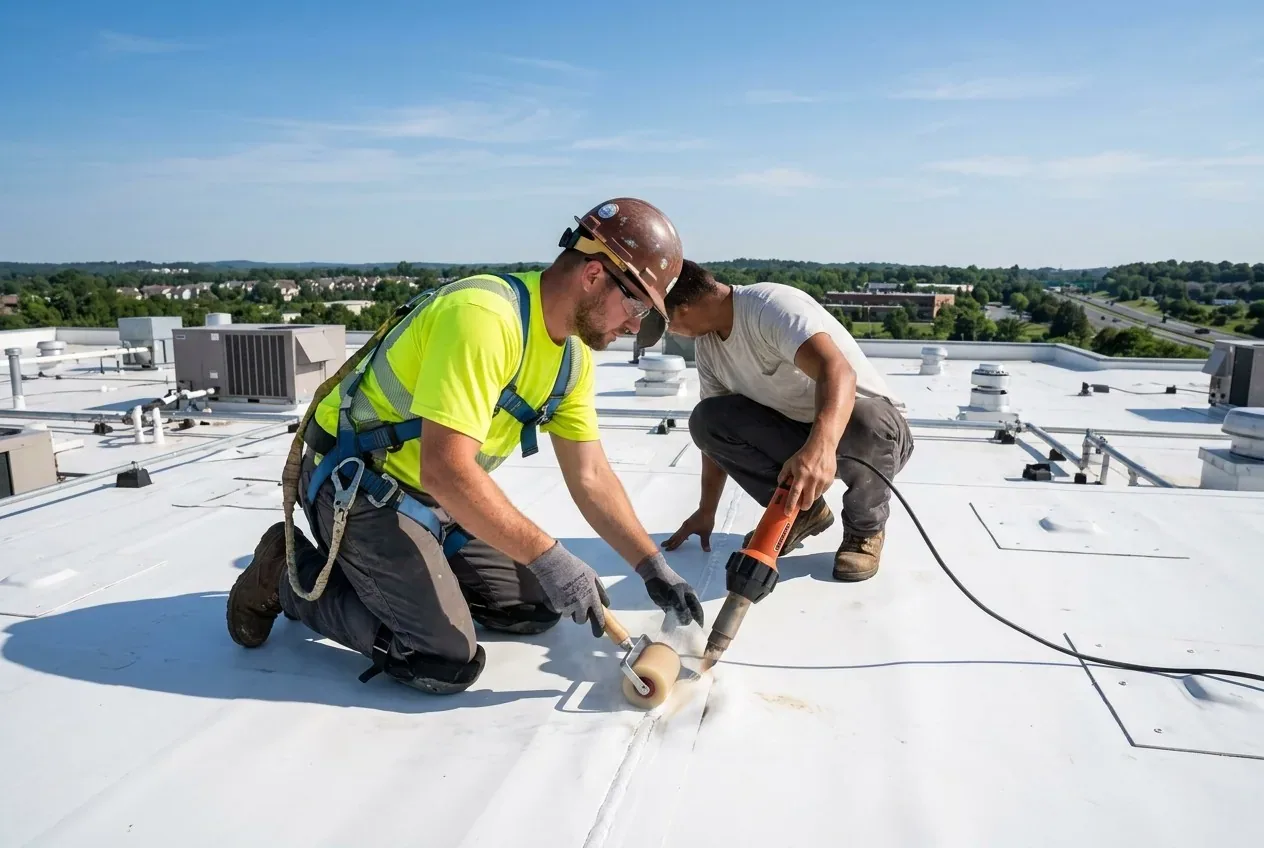
The repair method depends on the membrane and detail. A TPO seam calls for compatible materials and proper heat welding; an EPDM repair uses components intended for that rubber membrane. Metal roof work may involve a fastener, panel joint, flashing, or movement detail. Built-up and modified bitumen assemblies have different surface preparation and patch requirements. We identify the existing system before selecting materials, then remove loose or contaminated material and prepare a stable repair area. Putting new material over dirt, moisture, or a moving substrate can shorten the repair's useful life.
Flashing corners and curb transitions deserve careful attention because several materials meet in a small area. We look for separation, wrinkles, open terminations, cracked sealant, and stress from equipment movement. A patch that bridges a gap without restoring the transition can leave water a path behind the new material. Drain and scupper repairs also require checking the surrounding membrane and outlet condition. Where water collects because of slope or deck movement, a membrane patch alone will not correct the underlying condition. Review edge metal repairs and drainage detail work when the defect reaches those components.
Choose repair or broader work
Localized damage with sound surrounding material is a good repair candidate. Repeated failures in the same area, widespread wet insulation, loose attachment, or brittle surfaces may call for a wider scope. We explain the boundary between the repair and the roof area left in place. That boundary matters if the owner is deciding whether to stabilize a section now and budget for replacement later. A single repair cannot resolve separate defects elsewhere on the assembly.
Allen's businesses include finance, professional services, technology, telecommunications, and electronics. That mix can include rooms with sensitive equipment or continuous operations, but we confirm actual site needs rather than infer them from an industry label. Repairs can often be staged around operating areas, with temporary protection and a clear interior notification process. A time-sensitive dry-in may protect the building while a permanent repair is scheduled. If inspection shows broad deterioration, compare a replacement scope or a suitable recover instead of repeating isolated patches.
Check after the storm passes
The Dallas-Fort Worth metroplex sees spring thunderstorms capable of hail, damaging wind, flooding, and tornadoes. A regional weather report can identify a risk window, but it does not prove that a particular Allen property sustained roof damage. We inspect the actual roof for punctures, displaced edge metal, lifted membrane, broken accessories, blocked outlets, and water entry. Hail marks on soft metal components may help show exposure, but membrane condition and attachment still need direct review.
After a storm, temporary measures may be needed before all wet areas can be opened and repaired. We document the temporary work, note the location and materials used, and return for a permanent repair once the roof is dry and safe to access. This avoids confusing an emergency covering with a completed repair. When insurance documentation is required, photographs should show the observed condition and the repair performed, without extending claims beyond what the inspection supports. Our storm-damage service can coordinate the inspection and permanent work as one documented sequence.
Plan access and protect operations
Before mobilizing, we confirm roof access, keys or escorts, equipment clearances, work hours, and the route from the access point to the repair. A small leak may sit beside an air intake, solar equipment, or a restricted tenant area. We discuss protection for the space below and any equipment that must remain in service. For an occupied property, the site contact should know when work may create noise, odors, or temporary access limits. We keep the repair area controlled and clear loose materials before leaving.
Allen's Watters Creek office district sits alongside shops, restaurants, a hotel, and meeting space. A repair at a property in that broader district may need coordination around visitors as well as staff. At the end of the visit, the facility director receives the repair location, photos, materials used, and any follow-up observation. If moisture remains in insulation or interior finishes, the report distinguishes that condition from the completed exterior repair. A return maintenance visit can check the repair and nearby drainage details after weather exposure.
Match materials to the roof
Roofing products are not interchangeable across assemblies. We confirm the membrane or metal system, surface condition, and existing repair materials before bringing new components to the roof. TPO and PVC seams are welded using compatible techniques; EPDM patches rely on prepared surfaces and matching accessories. Modified bitumen and built-up roofs call for materials suited to their construction. Metal roofs require attention to fastener condition, panel movement, coatings, and flashing. The scope identifies the repair materials and the detail being restored.
Surface coating can protect a suitable roof or address a defined condition, but it does not repair wet insulation, unstable attachment, or an open drain. We check these conditions before recommending a coating-related repair. Allen adopted the 2021 International Building Code and International Energy Conservation Code, with local amendments and permit requirements to verify for applicable work. A TPO roof repair requires compatible welding and surface preparation; metal repair must account for fastener condition, panel movement, and flashing. If the proposed work changes drainage, structural loading, or fire classification, those requirements are part of planning.
Commercial Roofing Questions
Can you repair a roof leak from the inside?
Interior protection can limit damage, but the roof entry point must be found and corrected. We trace the water path and repair the exterior assembly where conditions allow.
How do you know whether one patch is enough?
We compare the defect with the surrounding membrane, insulation, attachment, and previous repairs. A wider pattern or wet assembly may call for a larger scope.
Can repairs be made while a commercial building is operating?
Usually the work can be planned around occupied areas. Access, noise, equipment, weather protection, and tenant notifications are coordinated with the site contact.
What happens when rain is still entering the building?
We prioritize safe access and temporary protection, then document a permanent repair plan once the affected area is safe and dry enough to work.
Do you repair different commercial roof types?
Yes. We identify the existing system first, then use materials and methods suited to that membrane, metal roof, or built-up assembly.